Biography
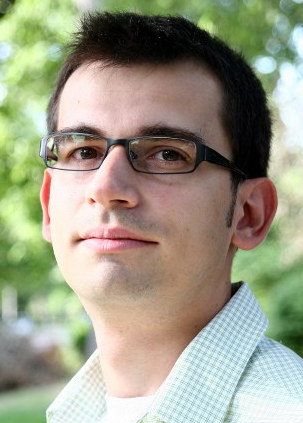
Emil Constantinescu is a Senior Computational Mathematician in the Mathematics and Computer Science (MCS) Division at Argonne National Laboratory, where he is a member of the Laboratory for Applied Mathematics, Numerical Software, and Statistics (LANS). He is also a Scientist at Large in the Consortium for Advanced Science and Engineering (CASE) at the University of Chicago. His research focuses on scientific machine learning and scientific computing for complex dynamical systems: uncertainty quantification, data assimilation and inverse problems, and robust time integration methods for stiff and multiscale dynamics, with applications in weather and climate, power grid operations, fluid dynamics, and nuclear physics.
In 2014, Constantinescu received the U.S. Department of Energy Office of Science Early Career Research Program award in applied mathematics for his work on quantifying structural errors in predictive scientific simulations. He is a long-time contributor to open-source scientific software, including the time-integration (TS) library in PETSc and DESolve.
He served as Associate Editor of the SIAM Journal on Scientific Computing (2014–2023) and as Secretary of the SIAM Activity Group on Uncertainty Quantification (2023–2024). He serves on the Scientific Committee of the Institute for Mathematical and Statistical Innovation (IMSI) at the University of Chicago and was the Argonne node director for the NSF-supported STATMOS research network for statistical methods in atmospheric and oceanic sciences (2013–2016). He co-organized the SIAM Conferences on Mathematics of Planet Earth (MPE18 and MPE26) and has organized numerous workshops and minisymposia at SIAM CSE, UQ, and MPE meetings, USNCCM, the Institute for Nuclear Theory, and Argonne, including the 2025 workshop on Foundation Models for the Electric Grid.
Mentoring is a central part of his work at Argonne. He has supervised or mentored more than 25 postdoctoral researchers and graduate students, many of whom now hold faculty and staff scientist positions, and has chaired Argonne’s Wilkinson Fellowship hiring committee. Constantinescu received his Ph.D. in computer science from Virginia Tech in 2008 and joined Argonne as the J.H. Wilkinson Fellow in scientific computing. He is a member of SIAM, IEEE, ACM, and the U.S. Association for Computational Mechanics.
Education
- Ph.D. in Computer Science, Virginia Tech, 2008. Dissertation: Adaptive numerical methods for large-scale simulations and data assimilation (advisor: Adrian Sandu)
- M.S., Automatic Controls and Computer Science, Politehnica University of Bucharest, Romania, 2002
- B.S., Automatic Controls and Computer Science, Politehnica University of Bucharest, Romania, 2001
Honors and awards
- Impact Argonne Award for notable achievement in program development, 2021
- DOE Office of Science Early Career Research Program award in Applied Mathematics, 2014
- Argonne Laboratory Director’s recognition for contributions to Argonne’s science, engineering, and technology programs, 2010
- J.H. Wilkinson Fellowship, Mathematics and Computer Science Division, Argonne National Laboratory, 2008
Selected service and leadership
- Associate Editor, SIAM Journal on Scientific Computing (2014–2023)
- Secretary, SIAM Activity Group on Uncertainty Quantification (2023–2024); SIAM Student Paper Prize committee (2026)
- Scientific Committee, Institute for Mathematical and Statistical Innovation (IMSI), University of Chicago (2022–present)
- Deputy Director, MACSER: Multifaceted Mathematics for Rare, High-Impact Events in Complex Energy and Environment Systems, a DOE ASCR initiative spanning nine institutions (2017–2022)
- Argonne node director, NSF STATMOS research network (2013–2016)
- Co-organizer, SIAM Conferences on Mathematics of Planet Earth (MPE18, MPE26); organizer of workshops at Argonne, the Institute for Nuclear Theory, and DOE, and of minisymposia at SIAM CSE, UQ, and MPE meetings and USNCCM
- DOE Computing Research Leadership Council mathematics visioning committee (2019); co-lead, “Convergence of Simulation and Data Methods” breakout at the DOE AI Townhall (2019)